Open-source biomedical research software
Trace disease evidence from claim to source.
NosoGraph connects disease knowledge from MONDO, HPO, literature, and clinical trials into typed claims — and keeps every claim's evidence direction and source provenance open to inspection.
This site is the documentation · the software runs locally · no hosted demo
Current scope
A broad registry, honestly labeled.
- Discoverable disease modules
- 10,404 full-corpus
- CI-validated modules
- 8 full-corpus gate
- Reference modules
- 6 full-corpus
- Strict L2-validated
- 88 n=500 sample
- Registered pipeline adapters
- 25 full-corpus
- Offline tests
- 2,445 v0.2.1 snapshot
Registry breadth is not curation depth. Validation figures marked sample describe an n=500 alphabetical slice of the registry, not the full corpus. How the registry counts work →
Positioning
Research software, with the boundary on the page.
NosoGraph is
- Open-source (Apache-2.0) software for biomedical research workflows.
- A typed-claims layer across ontologies, literature, trials, genetics, and target resources.
- Local software you run and inspect — a CLI, an API, and a dashboard.
- Provenance-preserving: source, snapshot, and import context travel with each claim.
NosoGraph is not
- Not medical advice, diagnosis, or clinical decision support.
- Not a hosted service — this site is documentation; the app runs on your machine.
- Not a replacement for the upstream sources it reconciles.
- Not a truth engine — computational rankings are hypotheses for review, never clinical certainty.
Choose your path
Inspect the evidence or extend the system.
Major capabilities
What you can inspect today.
Each surface is documented with its actual maturity. Nothing here is a clinical result.
Evidence Explorer
Inspect condition context, typed claims, and evidence direction in the local dashboard.
Read the guide → BetaEvidence Workspace
Turn selected evidence sources into a provenance-backed dossier, asynchronously.
Run it locally → BetaCompare conditions
Two to five conditions, explicit missingness, deterministic structured output.
Read the workflow → StableDisease registry
10,404 discoverable modules — breadth labeled separately from curation depth.
Understand the registry → StableCLI
Validate disease modules, sync sources, and run task-oriented analysis commands.
CLI guide → BetaAPI
Local FastAPI surface for diseases, evidence, provenance, and comparison.
API reference →The NosoGraph layer
From fragmented sources to inspectable relationships.
Biomedical resources are built for different questions. NosoGraph adds a computational layer across them — not a replacement — and keeps the distinction between source data, typed relationships, evidence, and provenance visible at every step.
- 01Source syncAcquire a resource record and retain its snapshot context.
- 02NormalizeResolve identifiers while retaining source vocabulary.
- 03Typed claimsRepresent explicit subject–predicate–object relationships.
- 04EvidenceKeep SUPPORTS, CONTRADICTS, and INCONCLUSIVE distinct.
- 05ProvenanceCarry source, snapshot, import, and fingerprint context forward.
Evidence is direction, context, and provenance — not a single score.
NosoGraph structures evidence for inspection. It does not automatically turn a claim into scientific proof or a clinical conclusion.
ASSOCIATED_WITH is a relationship type. It is not automatically CAUSES.
associated_with- SUPPORTS
- Evidence supports the claim; it is not a proven fact.
- CONTRADICTS
- Evidence disagrees with the claim; it is not automatic falsification.
- INCONCLUSIVE
- Evidence does not establish a clear direction.
- UNASSERTED
- No directional evidence is recorded.
Source ecosystem
Source context stays visible.
Source matrix
Representative resources shown below.
| Source | Role in NosoGraph | Integration maturity |
|---|---|---|
| MONDO | Disease ontology and identifiers | STABLE |
| HPO / HPOA | Phenotypes and annotations | STABLE |
| PubMed | Literature and evidence workspace | STABLE |
| ClinicalTrials.gov | Clinical study records | STABLE |
| Open Targets | Target–disease data and connector | BETA |
| GWAS Catalog | Genetic associations | BETA |
| bioRxiv / medRxiv | Preprint evidence workspace | EXPERIMENTAL |
Integration maturity describes NosoGraph's implementation state, not the scientific quality or clinical validity of an upstream resource. View the complete source matrix →
Two surfaces, one project
This site is the documentation. The dashboard is local software.
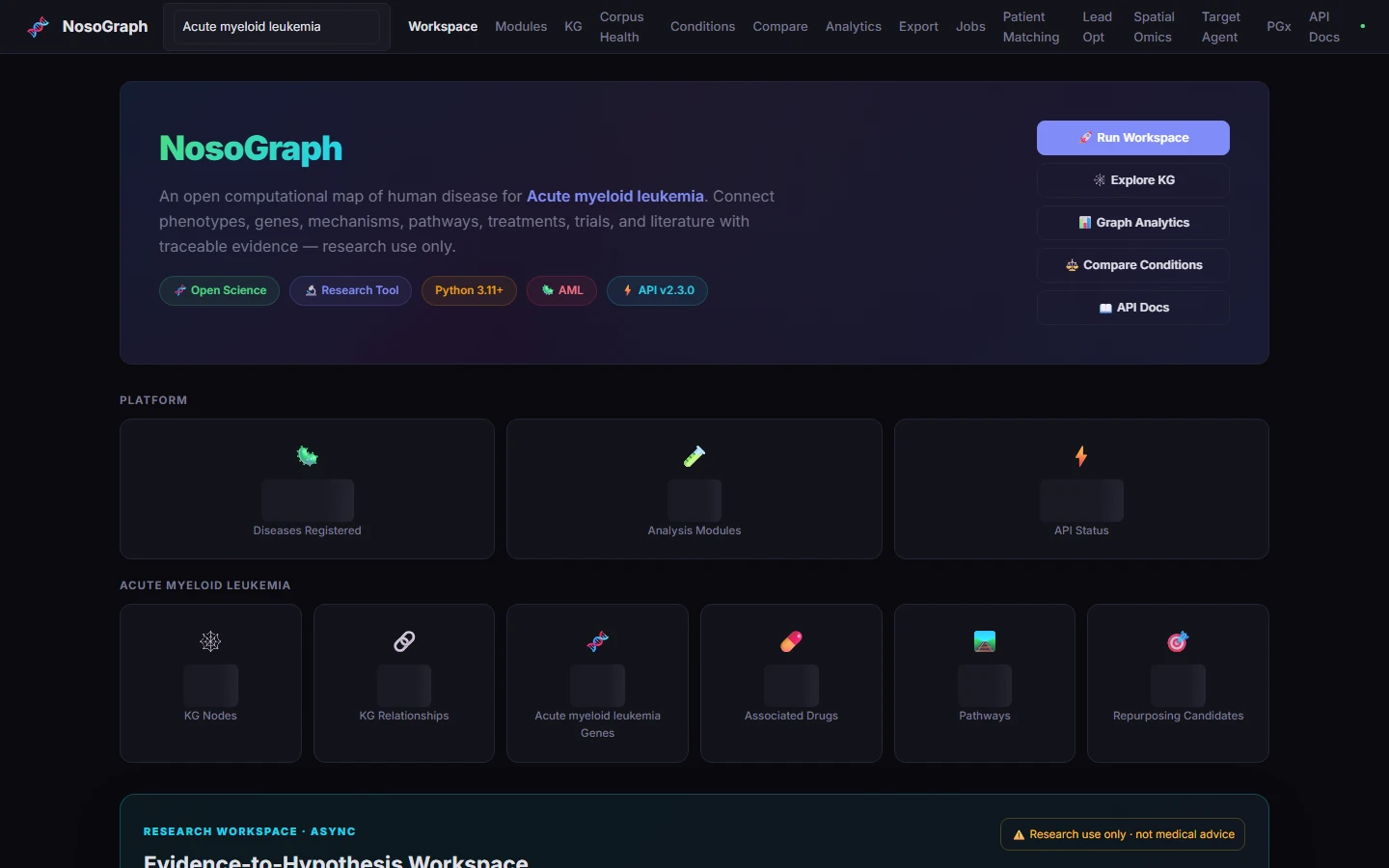
GitHub Pages hosts only these docs. The NosoGraph dashboard, CLI, and API run on your machine — every capture shown here comes from a local run, and there is no hosted demo to log into.
Researcher workflow
Start with a question. Follow the evidence.
A practical path from disease context to the next inspectable research surface.
- 01Choose context
Start with a disease module or research question, then check its curation and coverage context.
SLE walkthrough → - 02Inspect claims
Open the condition view and identify the exact relationship type instead of reading an unlabeled edge.
Evidence Explorer guide → - 03Review direction
Read SUPPORTS, CONTRADICTS, INCONCLUSIVE, or UNASSERTED as categorical evidence semantics.
Evidence concepts → - 04Trace context
Follow study/source metadata and the provenance chain; keep unavailable fields explicitly unknown.
Evidence tracing → - 05Compare if useful
Compare two to five conditions with explicit missingness when a cross-condition question is appropriate.
Compare workflow →
Research software for investigation — not medical advice or clinical decision support. Research-use boundary →
Developer path
Run it locally. Inspect the model. Extend the system.
NosoGraph is source-install software: use the CLI, local FastAPI surface, structured disease modules, and documented interfaces to inspect or extend research workflows.
git clone https://github.com/AdamEddahmouni/nosograph.git
cd nosograph
cp .env.example .env
docker compose --profile full up --build
Then open the local dashboard at http://localhost:8000.
make ci-localOpen source
Contribute to the parts you can inspect.
The project accepts focused improvements to code, curation, source context, documentation, and validation.
Good first issues → are listed with their intended area; governance and decision-making are documented publicly.
Disease Intelligence. Connected.
The research model is open to review — read the source, check the current status, or cite the project.
Apache-2.0 source · upstream data terms vary by source · v0.2.1 · Concept DOI 10.5281/zenodo.22055279